Nova Scotia offers you many opportunities for an exciting nursing career. First, you must become licensed to practice as a licensed practical nurse (LPN) or a registered nurse (RN) in the province. When you have your license, you can find employment in various settings.
Nursing Regulation in Nova Scotia
The Nova Scotia College of Nursing is the regulatory body for nurses in the province. The NSCN is responsible for issuing licenses and monitoring those who hold a license.
As reported in the NSCN Annual Report 2022, there were over 16,000 nurses in Nova Scotia, including nurse practitioners (NPs).
NPs are advanced practice nurses with a graduate-level education in nursing. As an IEN, you must first obtain an RN registration and licensure before you can be licensed as an NP in the province.
What is the difference between a licensed practical nurse (LPN) and a registered nurse (RN)?
LPNs and RNs are self-regulated nursing professions in Canada. There are similarities in their practice environments, but there are also significant differences in their educational training and scopes of practice.
LPN Education
LPNs complete a two-year diploma program at a college level before they are eligible to write the Canadian Practical Nurse Registration Exam and qualify for their nursing licensure.
LPN Practice
LPNs have core nursing knowledge to care independently for clients with an established plan of care. An integral part of the health care team, LPNs are accountable for providing safe, competent, ethical, and compassionate care to individuals, families, and communities.
RN Education
RNs complete a four-year baccalaureate program at the university level before they are eligible to write the NCLEX-RN Exam and qualify for licensure.
RN Practice
RNs work independently and collaboratively with others.
RNs consistently practise safely, compassionately, competently and ethically in diverse practice settings. They work with various clients at different levels throughout the continuum of health and illness.
RNs contribute to the healthcare system through direct practice, education, administration, research, regulation and policy.
Nursing registration requirements
There are two registration pathways for IENs in Nova Scotia.
The expedited pathway
This pathway is for IENs who are registered and hold a current licence that entitles them to practice as an RN in the Philippines, India, Nigeria, Australia, US, UK or New Zealand.
The non-expedited pathway
This pathway is for IENs who do not hold a current licence to practice as an RN in Canada or the seven designated countries.
NSCN Application Process for IENs in the Expedited Pathway
Did you complete your initial nursing education, and are you currently registered and licensed in good standing as an RN in the Philippines, Nigeria, India, USA, UK, Australia, or New Zealand?
If yes, you are eligible to apply to the NSCN under the expedited process.Read this FAQ by the NSCN to learn more about the expedited pathway.
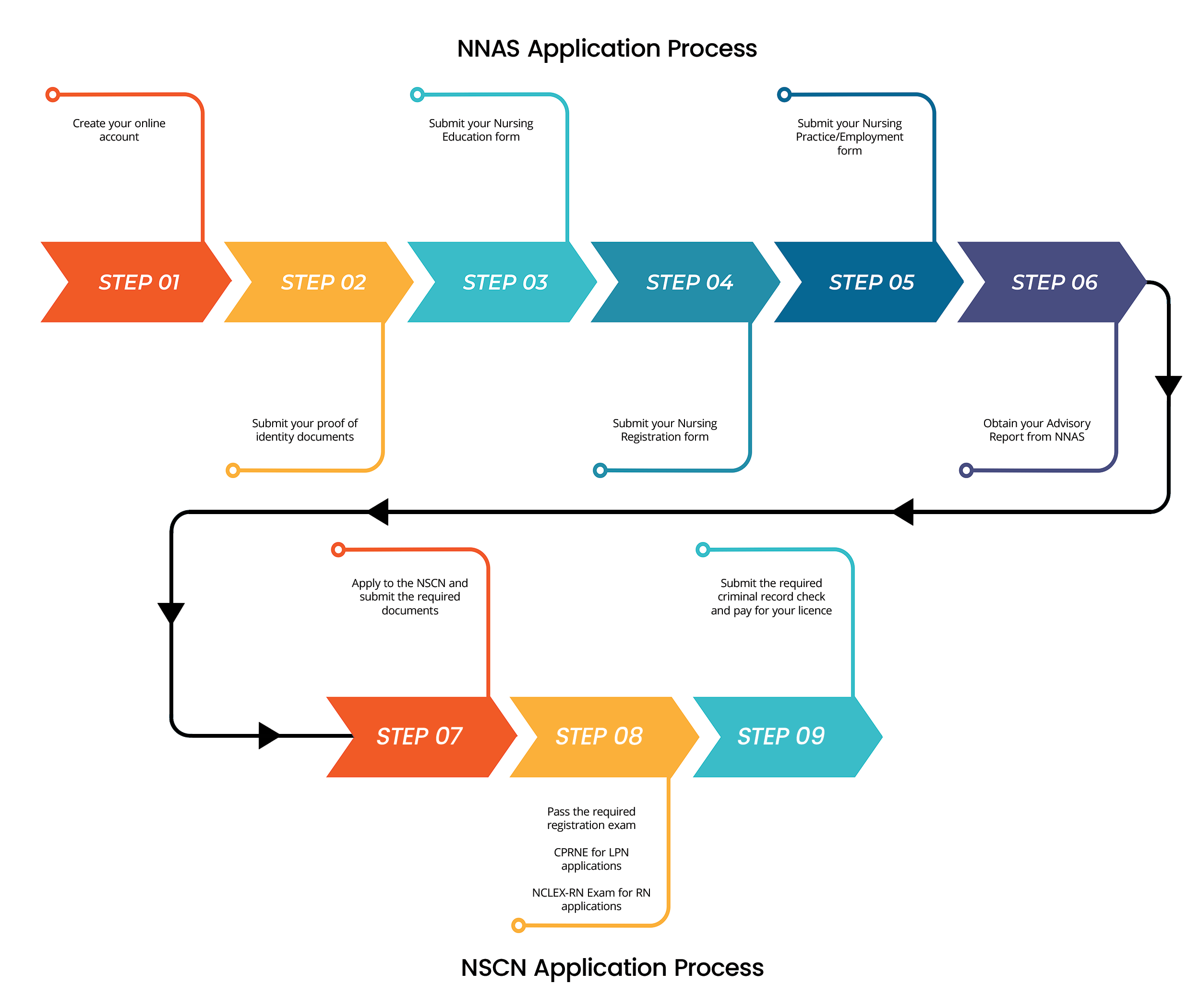
NNAS Application Process for IENs in the Non-Expedited Pathway
The National Nursing Assessment Service (NNAS) is a partnership of most Canadian nursing regulatory bodies to evaluate the applications of IENs in a timely and consistent manner.
The NNAS reviews, verifies, evaluates, and stores applicants’ documents to ensure that each nurse’s file contains all the documents that the regulatory body requires.
After you have submitted your application with the required documents and paid the applicable fees, NNAS will evaluate your application file. The reviewer will determine the authenticity of your documents and compare your education to the Canadian standard.
When this step is completed, the NNAS will provide you with an Advisory Report, which contains the results of the evaluation of your education based on Canadian standards and current nursing requirements. The NNAS will also send a copy of your report to the regulatory body that you have chosen.
Note that NNAS does not apply to the regulator on your behalf. You must do this yourself.
It is your responsibility to submit the required documents, pay applicable fees, and monitor your application to NNAS throughout the process.
Depending on your country of initial nursing education, registration, and practice, you may be required to demonstrate proficiency in English by completing an English language proficiency test.
Nursing education differs worldwide in its requirements, content, and delivery. Your nursing program may not have included all of the content taught in the Nova Scotia program.
When the NSCN assesses your nursing program, the College may find that you have some missing education or “educational gaps”. If you did not fill these educational gaps through continuing education or nursing experience, the NSCN may ask you to complete a competence assessment and/or a bridging/re-entry program.
Competence Assessment for LPN and RN Registration
If the NSCN finds educational gaps in your nursing program, you may be required to complete a competence assessment and any associated bridging education at the Learning Institute. The assessment is provided by the Nursing Community Assessment Service to determine whether an IEN applicant has the entry-level competencies expected of LPNs or RNs in Nova Scotia.
NCAS uses a combination of a Computer-Based Assessment (CBA) and a Simulation Lab Assessment (SLA) to assess how applicants demonstrate entry-level skills and competencies required for practice in their desired profession.
CBA and SLA must be completed within three months of each other.
The Nova Scotia Community College (NSCC) offers the LPN Re-Entry program. The NSCN will provide directions on how you can access the re-entry program.
The Learning Institute offers the NSCN-approved RN Bridging/Re-Entry program. RN bridging education may range from completing a theory course and/or a clinical course to completing a Canadian baccalaureate degree in nursing. Once the NSCN has given you the list of courses you are required to complete, you must contact the Learning Institute to discuss how to start your education.
Please note that you are responsible for any applicable fees associated with the competence assessment and/or bridging education.
All nurses in Nova Scotia, including IENs, must pass the national registration examination before they can become registered and licensed. The NSCN will evaluate your education to determine if you are eligible to write the exam.
Nursing jurisprudence is the application and interpretation of legal rules relating to nursing practice, obligations nurses have to their clients, and relationships nurses have with other health care professionals. New IENS are encouraged to be familiar with the jurisprudence information. Click here for more information.
IENs are required to meet the currency of practice requirement before they are eligible for registration. The currency of practice requirement refers to hourly requirements of nursing practice as an RN or LPN.
There are various ways by which you can demonstrate your currency of practice, including:
Current licensure in another Canadian jurisdiction in the same designation you are applying for.
Current licensure as an RN in another jurisdiction as designated by the CEO, including the Philippines, Nigeria, India, US, UK, Australia or New Zealand.
Practice no later than three licensing years prior to your application.
Practice a minimum of 320 hours of practice no later than five licensing years prior to your application.
Passed the registration exam no later than three licensing years prior to your application.
Successfully completed a re-entry program, bridging education, or entry-level nursing program, no later than five licensing years prior to your application.
Successfully completed a competence assessment and bridging education no later than five licensing years prior to your application.
Visit the NSCN website to learn more about demonstrating your currency of practice.
Note:Effective January 2, 2024, RN applicants who have passed the NCLEX exam more than three years ago and have not worked as an RN in the last ten licensing years will be required to complete a competence assessment and bridging education or a nursing re-entry program, unless they meet one of the other currency of practice options.
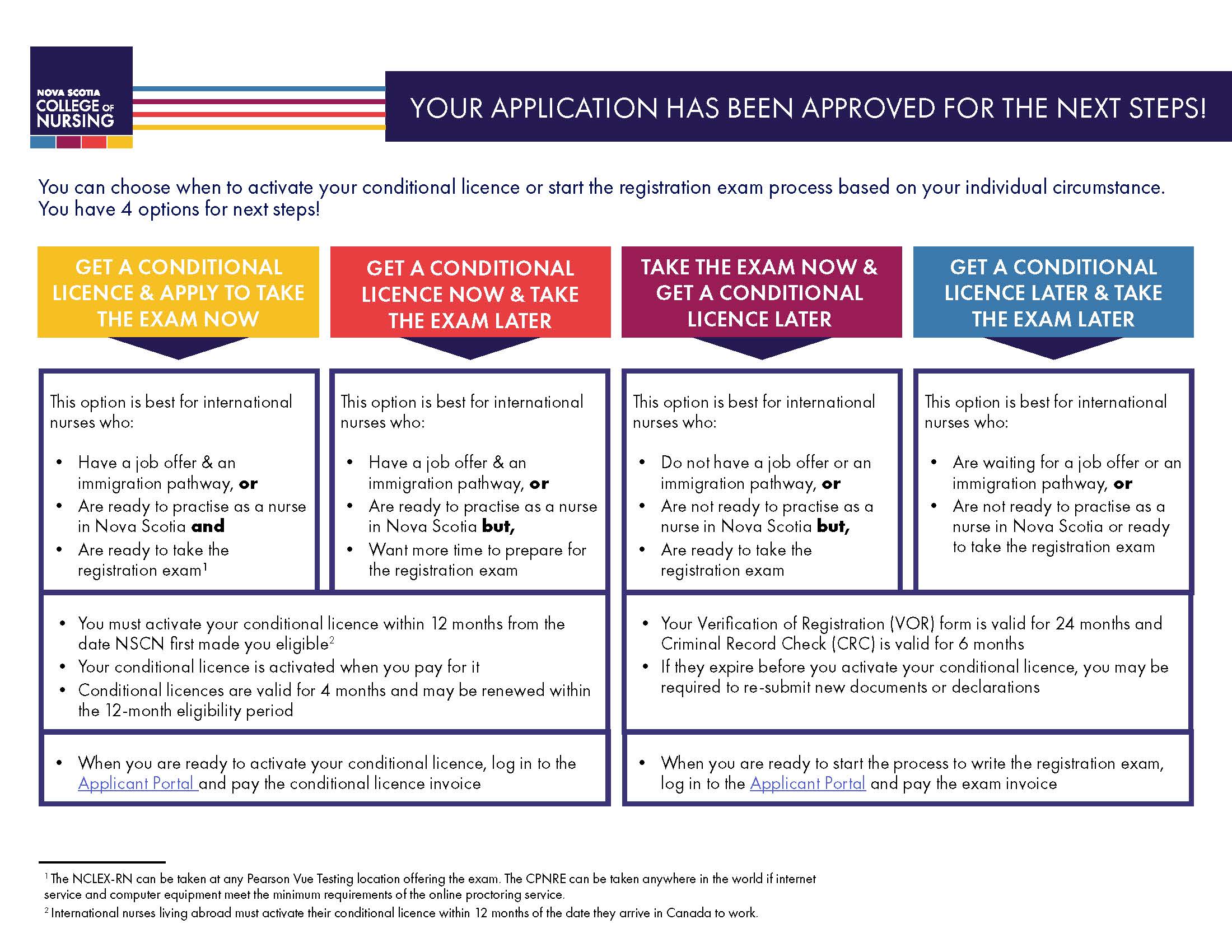
While waiting to write the nursing registration exam, you can apply for a conditional license with the NSCN. This license allows you to work in a Nova Scotia practice environment. However, you must be aware of and abide by the restrictions associated with your conditional license. See the infographics below and click here to determine when to activate your conditional license.